PropellerAds vs RichAds 2026: The Smarter iGaming Pick
If you buy traffic for iGaming offers, two names come up in almost every affiliate conversation: PropellerAds and RichAds. Both are established performance networks, both handle iGaming campaigns, and both are frequently cited when affiliates discuss where to source players.
The honest answer to “which one is better?” is that neither wins outright — they're built differently, and the smart move is to understand those differences before you spend a dollar.
TL;DR — RichAds and PropellerAds are both strong, established networks for iGaming traffic, and neither is a clear winner. RichAds carries more format variety (native, calendar push, display) and hands-on managed support with daily whitelist curation.
PropellerAds runs on a longer track record, higher total impression volume, and an engagement-gated Interactive Ads format that pre-qualifies clicks.
GEO coverage and pricing are near-identical ($100 minimum on both). The only reliable way to decide is to run the same offer on both simultaneously through a tracker and compare at the placement level.
This comparison breaks down formats, GEO coverage, anti-fraud, interface, and pricing so you can decide which network fits your specific offer — or, more realistically, run both and let the data decide.
PropellerAds vs RichAds: Quick Comparison at a Glance
| Parameter | PropellerAds | RichAds |
|---|---|---|
| Founded | 2011 | 2018 |
| Ad formats | Push, in-page push, popunder, interstitial, Telegram Mini App ads, Interactive Ads, Social | Push, in-page push, calendar push, pops (popunder/clickunder), native, display, direct click, Telegram |
| GEO coverage | 195+ GEOs (100% coverage via popunder) | 200+ GEOs, Tier 3 to Tier 1 |
| Daily impressions | 15B+ across all formats | 5B+ on push alone |
| Reach | 2B+ users; 50,000+ brands, agencies and affiliates | Not publicly specified |
| Optimization | CPA Goal, automated rules, multi-format campaigns | Performance Mode, Manual CPC, Target CPA |
| Anti-fraud approach | Multi-layer filtration (Adex + Internal Shield); eliminates 98% of non-human activity pre-bid | Managed whitelists, daily source refreshing via Performance Mode |
| Minimum deposit | $100 | $100 |
| Bidding models | CPM, CPC, CPA Goal, SmartCPM | CPC, CPM |
| Support | 24/7, multilingual, dedicated account managers | Dedicated managers, whitelists and bid guidance |
| Certifications | IAB Europe member, ISO/IEC 27001 | SiGMA Europe “Best iGaming traffic source” 2022 |
Why compare these two networks
RichAds and PropellerAds occupy overlapping territory. Both are self-serve ad platforms aimed at affiliates and media buyers, both lean heavily on push and pop formats, and both position themselves as sources of high-volume traffic for verticals including iGaming.
In the US market and across Tier 1 GEOs, they're among the most frequently cited ad networks for this kind of traffic.
The reason a side-by-side matters is that the surface similarities hide meaningful differences in format range, geographic depth, and the kind of hands-on support you get. Picking based on a single review or a friend's recommendation usually means you optimize for the wrong variable.
Formats: what each network offers
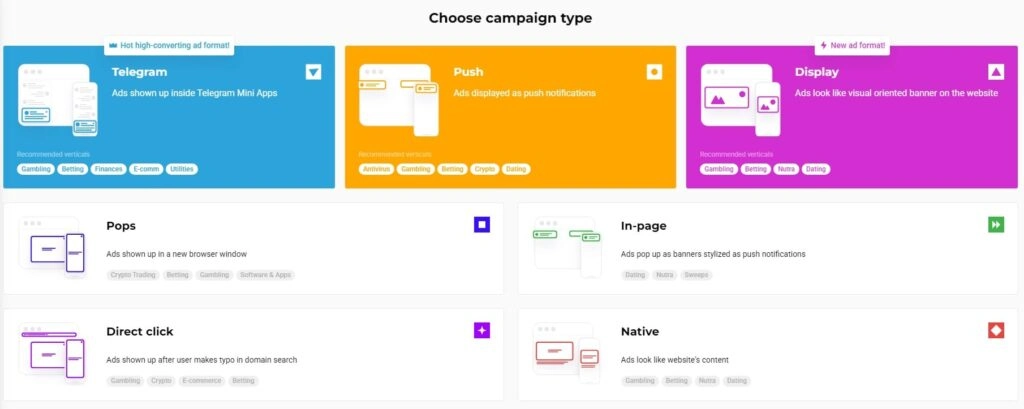
RichAds started as a push-notification network and has since expanded. Today it runs push (classic and in-page), pops (popunder and clickunder), native ads, domain redirect / direct click, display, calendar push, and Telegram ads. The addition of native and display gives affiliates more creative surfaces to test under one roof.
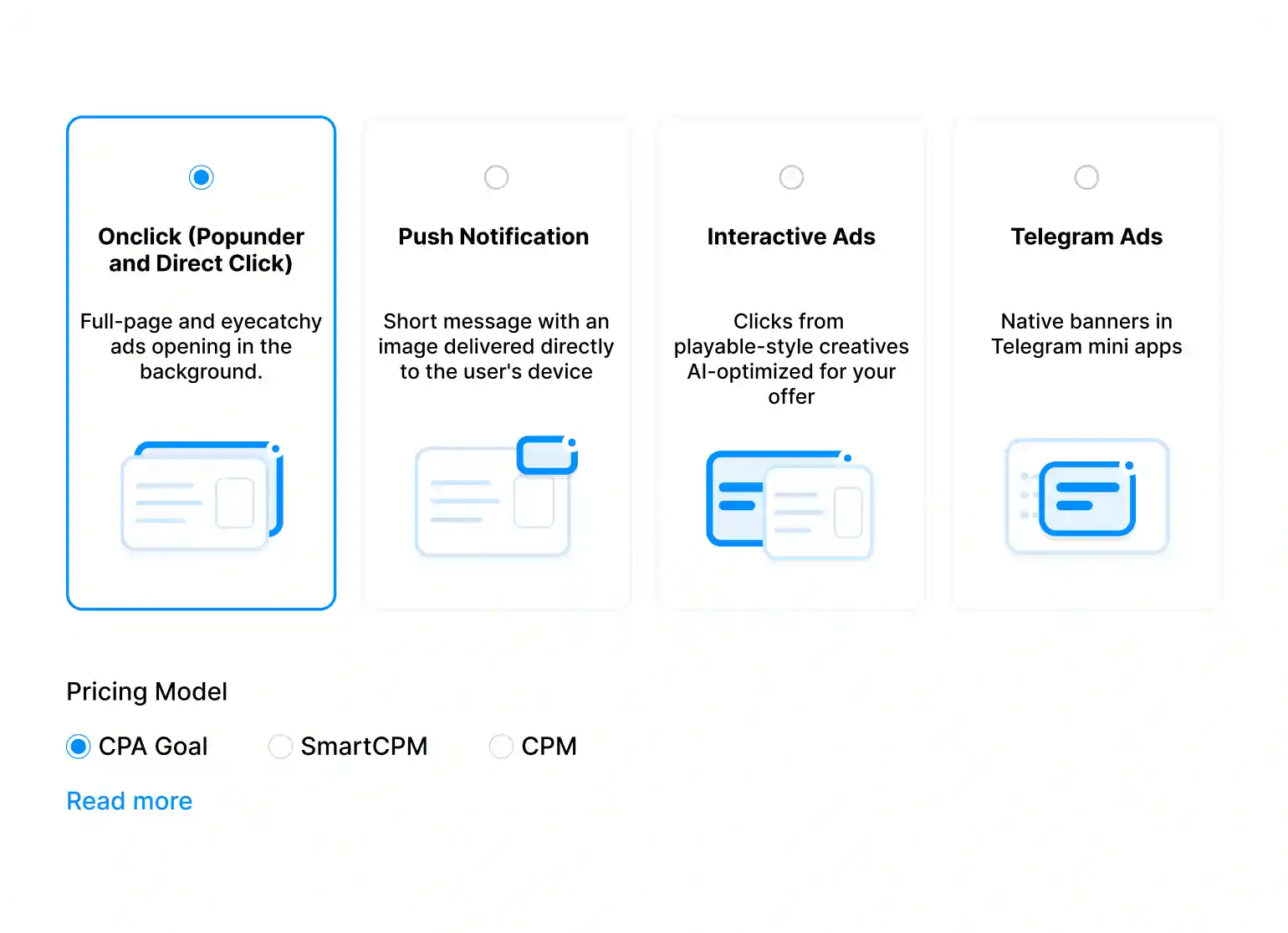
PropellerAds covers push notifications, in-page push, popunder, interstitial, Telegram Mini App ads, Interactive Ads, and paid social, with AI-based optimisation tools including CPA Goal bidding. Interactive Ads launched in 2026 — a format designed to reduce wasted clicks by engaging users with a short mini-flow before they reach a landing page.
|
AI-Based Campaign Control
Set your conversion target and let CPA Goal optimise delivery
PropellerAds combines automated optimisation tools with CPA Goal bidding to help advertisers manage traffic around a target acquisition cost.
|
RichAds — formats:
PropellerAds — formats:
The practical difference: RichAds adds native and calendar formats, while the second network emphasizes interstitial and its engagement-gated Interactive format.
If your creative strategy depends on native placements, RichAds has the edge in coverage; if you want a pre-qualification step before the click, the interactive approach offers that. Both share the core push/pop/in-page trio that most iGaming affiliates rely on.
GEO and traffic volume
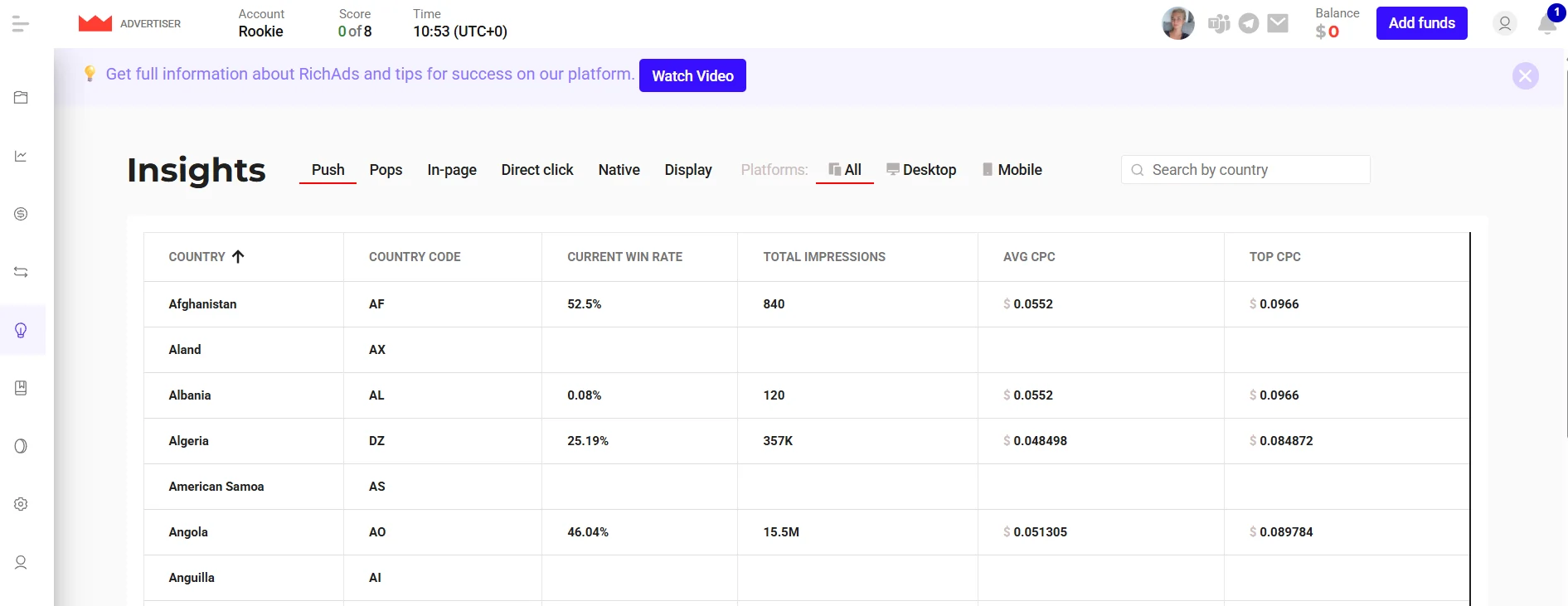
Both networks operate at global scale. RichAds offers traffic across more than 200 GEOs from Tier 3 to Tier 1, with over 5 billion daily impressions on push alone.
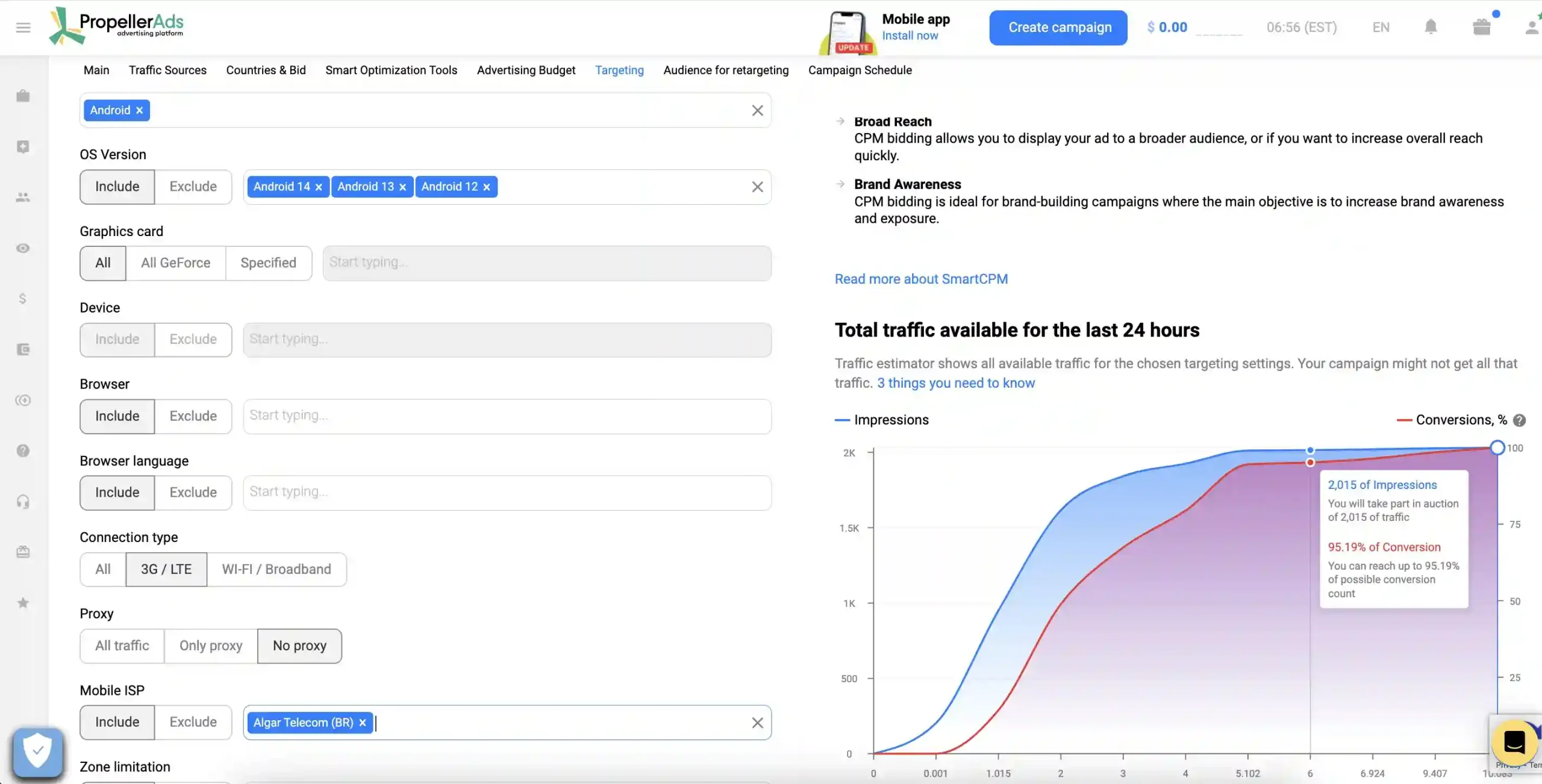
PropellerAds reports 100% coverage across 195+ GEOs and access to more than 15 billion daily ad impressions across all formats, reaching an audience of 2 billion users.
RichAds — GEO & volume:
PropellerAds — GEO & volume:
In headline numbers, one platform cites broader total impression volume and the other a slightly higher GEO count — both are firmly in the same tier. For most affiliates the difference won't be about whether a GEO exists on the platform, but about traffic density in the specific countries their offer targets. Which is exactly why testing both matters.
Anti-fraud
quality is where affiliate budgets quietly leak, so both networks invest here.
PropellerAds runs multi-layer fraud filtration combining a dedicated anti-fraud partner (Adex) with an internal shield, and reports eliminating 98% of non-human activity pre-bid so advertisers acquire verified audiences only.
The Interactive Ads format adds another layer: engagement mechanics act as an additional filter, intended to ensure only real users proceed to the offer.
RichAds applies its own traffic-quality controls through source scoring and whitelisting. Its managers assist with setting campaign parameters, choosing the optimal bid, and providing whitelists matched to the offer.
Performance Mode automates part of this: the system updates whitelists with the best-performing sources daily.
RichAds — anti-fraud:
PropellerAds — anti-fraud:
Both take fraud seriously with different emphases — one foregrounds automated pre-bid filtration and engagement filtering, the other foregrounds managed whitelisting and daily source refreshing.
Interface and ease of use
Both platforms are self-serve with modern dashboards, real-time reporting, and automated optimization.
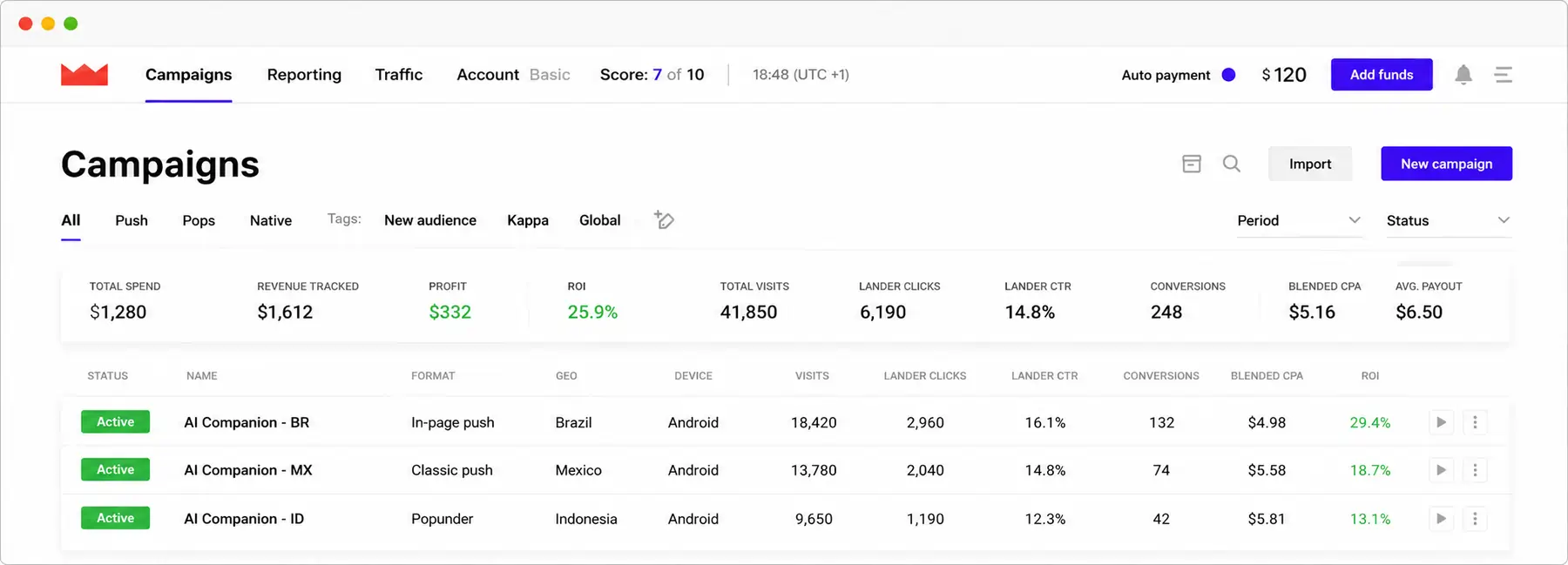
RichAds offers three optimization options: Performance Mode, Manual CPC, and Target CPA, and provides real-time reporting with breakdowns by zone, device, OS, browser, and more. Performance Mode is aimed at beginners and experienced buyers alike.
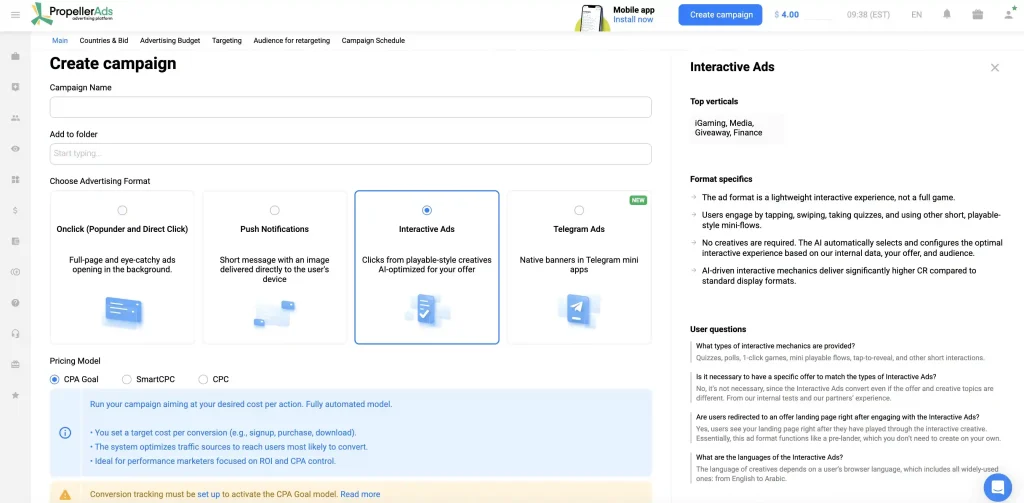
The comparison platform offers comparable automation. Its CPA Goal tool learns from campaign performance and automatically adjusts bids, automated rules pause poor-ROI zones or raise bids on high-converting placements, and a Multi-format Campaign feature converts one campaign into three formats — push, popunder, and interstitial — in a few clicks. An AI campaign assistant can spin up a campaign from a plain-language brief.
Minimum deposits sit at the same $100 entry point on both sides. The interfaces are close enough in capability that preference usually comes down to workflow habits rather than a clear functional gap.
When to choose which
Neither of these is a “better network” call — it's a fit call based on your formats, GEOs, and how much manual control versus automation you want.
FAQ
Is PropellerAds or RichAds better for iGaming traffic?
Both are strong options. PropellerAds offers more formats and broader GEO coverage, while RichAds provides more gambling-specific support. The best approach is to test both networks simultaneously with the same offer and compare results.
Can I run the same iGaming offer on both networks?
Yes — using a tracker like Voluum, you can run the same offer on both networks simultaneously and compare performance at the placement level.
What ad formats does each network support?
One supports push, in-page push, popunder, interstitial, Telegram Mini App ads, Interactive Ads, and social. The other supports push, in-page push, calendar push, pops, native, display, direct click, and Telegram ads.
Which network has broader GEO coverage?
The figures are close: 195+ GEOs with 15B+ daily impressions versus 200+ GEOs from Tier 3 to Tier 1 with 5B+ daily push impressions. Both operate at global scale, so density in your target GEOs matters more than the headline count.
Do both networks have anti-fraud protection?
Yes. One uses multi-layer pre-bid filtration removing 98% of non-human activity plus an engagement filter via Interactive Ads; the other uses managed whitelists and daily source refreshing.
What is the minimum deposit?
Both networks start at $100.
The bottom line: test both
The most reliable answer doesn't come from a comparison article — it comes from your own data. Run the same offer on both networks simultaneously, hold your creatives and targeting constant, and compare at the placement level. A tracker like Voluum makes this straightforward and removes the guesswork.
Both networks are strong enough that the winner will almost always be decided by how your specific offer performs on each — not by which one looks better on paper.